
Adam Roa at AUREA: You Are the Hose, Not the Water
Most people treat creating as a problem to solve. The spoken word artist behind "You Are Who You've Been Looking For" treats it as plumbing, and gave AUREA the four-step process he uses for everything he makes.
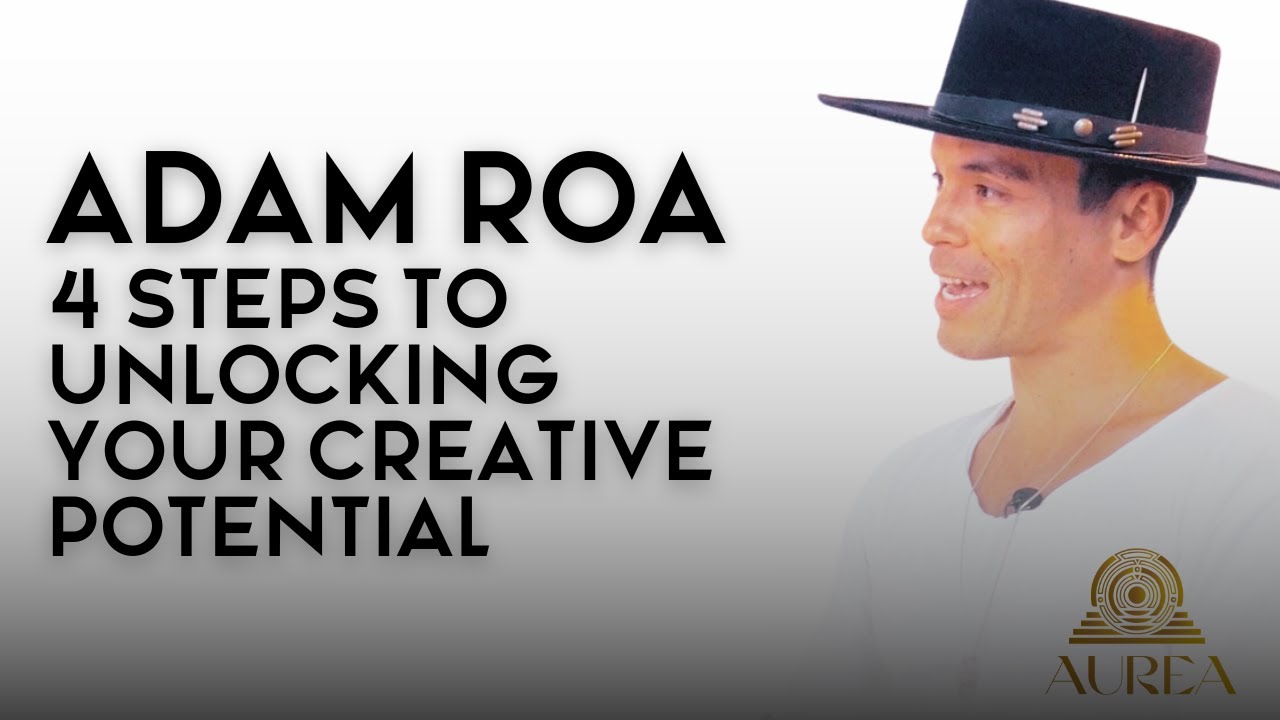
Adam Roa is a spoken word artist, coach and speaker, and he came to AUREA with a working method rather than an inspiration talk.
His starting objection is with how most people hold creativity in the first place. They see it as something you go in and figure out, by force, at a desk.
"I see creativity as more of a receiving and birthing experience, as much as a man can imagine."
Which means the work is not manufacturing the water. It is being a clean channel for it. Hence the metaphor he builds the whole process on: you are a garden hose.

Step one: why you have to unkink the hose first
A bent hose passes no water no matter how good the tap is.
The kinks are your fears, your doubts, your insecurities, your limiting beliefs. They are the creative problem. Nothing downstream works until they are cleared, which is why so much creative block is actually unprocessed fear wearing a beret.
Step two: why you have to connect to the source
This is the step almost nobody does consciously, and it is the sharpest question in his talk.
"When we're creating, where are we pulling from? Are we pulling from the version of reality in which our poem never gets finished, or the version in which it goes on to reach hundreds of millions of people?"
You are always connected to something. The only question is which future is feeding the line while you work. Most people write from the reality where it fails, then wonder why the work comes out small.
Step three: how you turn up the flow
Here is where the unglamorous part earns its place. Your routines, your habits, your diet, your sleep. Every one of them either raises or lowers the volume of energy available to the thing you are trying to grow.
This is the pressure in the line.
Step four: how the water actually leaves you
The last step is the nozzle. Thumb over the end, jet, sprinkler, whatever. It is the specific way the water leaves you.
Your story. Your skills. Your talents. Your style. Same water as everyone else is drawing on; entirely different spray pattern. People mistake this for the whole of creativity. It is actually the last quarter of it.
"What I create is so much more impactful, more fun for me, and more transformational for everyone involved when I use that process."

What if you don't think you're an artist?
He hears it constantly, and he does not accept the premise. Ask people what art is and they say music, singing, dancing, drawing. His definition is wider and much more demanding:
"Art is the expression of creative energy into tangible form."
Which makes art out of how you cook a meal for your family. How you organise a closet. The app you design. The way you do your taxes, if you bring your own creative essence to it.
And his proof is disarming: if you have ever said a sentence that nobody handed you to read, you created it. It came through you, in the moment, improvised. You have been doing this all day, every day, without giving yourself credit for it.
"No matter what industry you're in, you will be happier if you bring more of your creativity to what you're doing."
What the Golden Age actually is
Asked what the Golden Age looks like, his answer is one sentence: everyone living their dharmic path, in alignment with their soul's calling.
His reasoning is ecological. We speak about "going into nature" as though it were somewhere else, when we are nature. And nature does not make mistakes; it runs on symbiosis.
Think of a colony. If the worker bees decide to do something other than what they are for, the colony stops working. Humans arrive with the same built-in inclinations (the things we love, the things that pull our curiosity), and then get told to be realistic, or fall in line, or do what the culture requires.
"That gets people off their alignment, and when that happens we drop out of that symbiotic relationship with nature."
His claim is that a great many of our collective problems are downstream of that single misallocation. Millions of people are in the wrong role, and those problems would begin resolving themselves if enough people simply took up their actual one.
What this all means for your own creative block
You are not required to generate the water. You are required to be un-kinked, connected to the right source, running at pressure, and shaped like yourself at the end.
And if you have been waiting for permission to call what you do creative, he is not going to give it to you, because you never needed it. You have been making art since the first sentence you spoke that nobody wrote for you.
Watch the full conversation above.
Frequently asked questions
What does "you are the hose, not the water" mean?
Creativity isn't something you manufacture by force. It's something you channel. The work isn't generating the water; it's being a clean, unkinked channel for it. Fears, doubts, and limiting beliefs are the kinks that block the flow before anything else can work.
What's the four-step process Adam Roa teaches?
Unkink the hose (clear the fears and limiting beliefs blocking you), connect to the source (notice which version of the future you're actually creating from), turn up the flow (your habits, sleep, and routines raise or lower the energy available to the work), and spout it out (your specific style, the nozzle the water leaves through).
What if I don't consider myself an artist?
His definition of art is wider than most: the expression of creative energy into tangible form. That includes how you cook a meal, organize a closet, or do your taxes. His proof: if you've ever said a sentence nobody handed you to read, you created it. You've been doing this all day without giving yourself credit.
What does Adam Roa think the Golden Age actually looks like?
Everyone living their dharmic path, in alignment with their soul's calling. His reasoning is ecological: nature runs on symbiosis, and when people get pulled out of alignment with what they're actually for, we drop out of that same symbiotic relationship, the same way a colony breaks down if worker bees stop doing what they're for.
Back to Wisdom